
Smart Agriculture

Table of Contents

INTRODUCTION

Smart agriculture is a term used to describe the use of technology in the management of agricultural production, such as the use of sensors, remote sensing, big data analytics, artificial intelligence, and robotics, to optimize crop yields and quality, reduce input costs, and increase efficiency. Smart agriculture can also be used to improve sustainability, reduce environmental impact, and track inputs and outputs to ensure food safety and security.
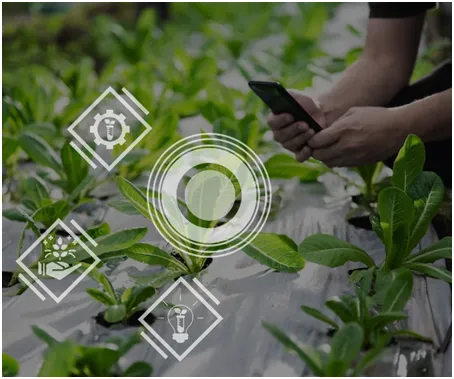
Smart agriculture is a system that uses IoT (Internet of Things) and has the potential to revolutionize the agriculture industry. IoT technology can be leveraged to gather real-time data about soil, water, weather conditions, and other environmental factors. This data can be used to optimize agricultural operations and increase yields. IoT can also be used to monitor the health of crops and livestock, as well as detect pests and diseases.
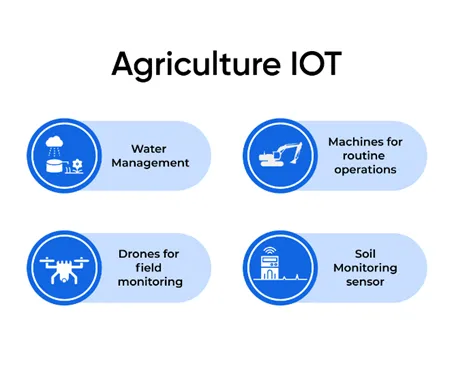
The Internet of Things (IoT) plays an important role in smart agriculture for farmers. IoT technology can help farmers to increase their crop yields, reduce costs, and maximize their profits. It can also help farmers to better manage their resources and optimize their operations.
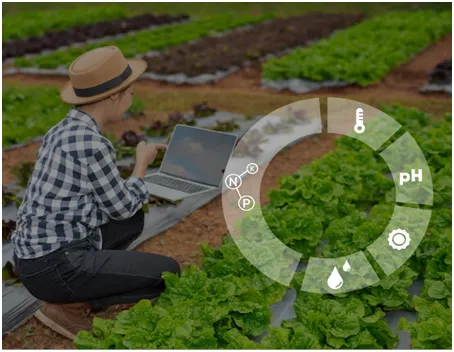
IoT can facilitate real-time monitoring of soil conditions, water levels, and temperatures.

IOT make agriculture smart by using hardware and software as well.

HARDWARE

Mobile app module

An application that gives farmers and other agricultural stakeholders access to the most recent crop data and other pertinent information about their crops is referred to as a mobile app module in smart agriculture. This can include

details about the state of the soil, the climate, and crop yields. With the aid of this program, farmers may make smarter choices regarding their crops, which will raise yields and earnings.

Agro Cloud Module

In order to connect farmers and other agricultural stakeholders with cloud-based software applications and services, cloud app modules are used in smart agriculture. These modules can be used to gather data from many sources, process it, and store it before displaying it to the user in a clear manner. This can assist farmers in managing their farm operations and finances by giving them access to the most recent crop price, weather, and market information.

GSM module

Farmers may use GSM apps as a useful tool for smart agriculture. With the use of these apps, farmers can obtain current climate and meteorological data, track crop health, check soil moisture levels, and get alerts about pest and disease outbreaks. Farmers can use GSM apps to make better judgements regarding irrigation, fertilizer, and other farming techniques. GSM apps can also give farmers access to banking services, information about their local markets, and market prices.

Soil moisture sensor

The soil moisture sensor is crucial to smart agriculture because it offers precise data on the amount of soil moisture in a specific area. In order to ensure that their plants receive the proper amount of water for optimal growth, this knowledge assists farmers in maximizing the amount of water they must utilize for their crops.

Temperature sensor

Temperature sensors are an important tool in smart agriculture. Temperature sensors help farmers monitor the temperature of their crops and the environment, so they can make informed decisions about when and how to best manage

their crops. Temperature sensors can also alert farmers when the temperature is too high or too low, so they can take proactive steps to ensure the health of their crops.

PIR sensor

The PIR (Passive Infrared) sensor is a popular and important device for smart agriculture. It is a motion detector that uses infrared light to detect movement within its field of vision. The sensor can detect changes in infrared radiation emitted by objects in the environment, such as animals, people, or machinery. PIR sensors can also be used as part of an automated irrigation system to conserve water and ensure that plants get the water they need.

Big Data Analysis

Smart agriculture can benefit significantly from big data analysis. It can be used to track and examine environmental aspects like weather patterns, crop yields, and soil conditions. With the aid of this knowledge, farming operations may be made more effective and sustainable, water and fertiliser use can be tilizati, and crop yields can be raised. In addition, crop failure risk can be calculated and pests and diseases that may be harming crops can be found using big data analysis. Finally, big data analysis can be tilizat to guide farmers in choosing the right crops, planting sites, and harvest windows.

SOFTWARE

Proteus 8 simulator

The development of intelligent agriculture can be significantly aided by Proteus Simulator. Users can test various farming scenarios and improve resource tilization while gaining data-driven insights by using it to build virtual farm environments. The simulator may be used to create farming robots and other equipment that can automate the operation, increasing productivity and reducing costs. The simulator can also be used to create smart sensors and

other Internet of Things (IoT) technologies that can track crop health, soil moisture, and other crucial aspects of productive farming.
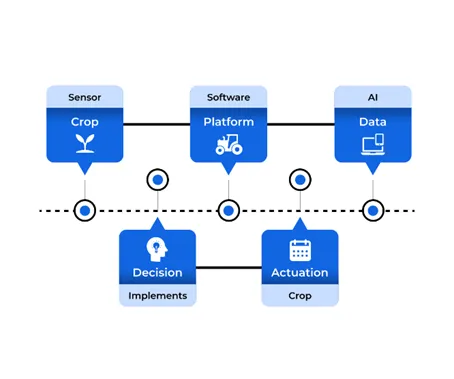
Benefits of Smart Agriculture

  1. Data control
  2. Control over the risk
  3. Automation and efficiency
  4. Better quality products

PROBLEM

  1. Data Security: As with any system connected to the internet, IOT-enabled smart agriculture systems are vulnerable to cyber-attacks. These attacks can lead to stolen data, malicious manipulation of data, or the destruction of data and physical assets.
  2. Interoperability: Many of the IOT-enabled devices used in smart agriculture are proprietary and often do not communicate with each other. This can lead to compatibility issues, which can make it difficult to integrate new systems or technologies into existing ones.
  3. Cost: Smart agriculture systems can be expensive to implement, as they require specialized hardware, software, and infrastructure. This cost can be prohibitive for some farmers and farmers’ cooperatives, especially in developing countries.
  4. Environmental Impact: IOT-enabled devices can consume a significant amount of energy,

resulting in a negative environmental impact if the energy sources are not sustainable. Additionally, the use of IOT-enabled devices can lead to an increase in the use of certain pesticides and fertilizers, which can have an adverse impact on the environment.

SOLUTION

Hardware based security modules can be used as a root of trust anchor to provide an additional layer of security to smart agriculture systems. By using state of the art cryptographic algorithms, the security module can be used to securely authenticate users, encrypt data transmission, and prevent malicious attacks. Additionally, the module can be used to monitor and detect anomalies, detect malicious code, and provide secure authentication for remote access and control of the system. By providing a secure foundation, the security module can help reduce the risk of cyber-attacks and protect the data and resources of the smart agriculture system.
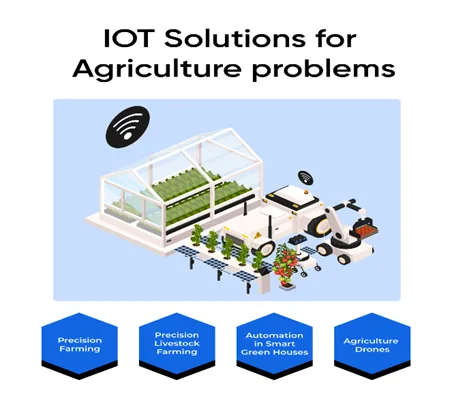
Connected greenhouses use sensors and other technologies to monitor temperature, humidity, and light levels, and can be used to control the environment for optimal growth. Irrigation systems use sensors to measure moisture levels and regulate irrigation automatically. This can help farmers conserve water and ensure that their crops always have the right amount of moisture.

Crop monitoring systems use sensors to measure plant growth and detect pests and diseases. Thisdata can be used to develop strategies to maximize yields and ensure the health of crops.

APPLICATION

Nova Automation Technology is playing the following vital role in smart agriculture;

  1. Automated Irrigation: Automated irrigation systems are increasingly being used in smartagriculture to monitor soil moisture levels and control irrigation systems accordingly.
  2. Automated Greenhouse Monitoring: Automated systems can be used to monitor and adjust levels of temperature, humidity and light in greenhouses.
  3. Robotic Harvesting: Nova automation technology can be used to develop robots for harvesting, sorting, and packing produce.
  4. Automated Animal Tracking: Automated systems can be used to track and monitor the location, health, and activity of livestock.
  5. Precision Farming: Nova automation technology can be used to develop automated systems for precise fertilizer application, weed control, and crop monitoring.

REFERENCES(Google Scholars)

  1. Sahoo, S., P. Panda, and S. R. Mohanty, “A survey on Internet of Things (IoT) enabled smart agriculture,” Comput. Electr. Agric., vol. 145, pp. 163–179, 2018.
  2. Kumar, S., S. K. Singh, and A. Kumar, “Smart agriculture using Internet of Things (IoT) and its applications,” Int. J. Innov. Res. Sci. Technol., vol. 4, no. 1, pp. 497–501, 2018.
  3. Kumar, K. A., S. K. Singh, and M. S. Sharma, “Smart Agriculture Monitoring System Using Internet Of Things (IOT),” Int. J. Eng. Innov. Technol., vol. 8, no. 6, pp. 5–9, 2019.
  4. Bhardwaj, F., and M. K. Dhar, “Smart Agriculture: A Review of Internet of Things (IoT) Enabled Applications and Solutions,” Sustainability, vol. 11, no. 8, pp. 1